
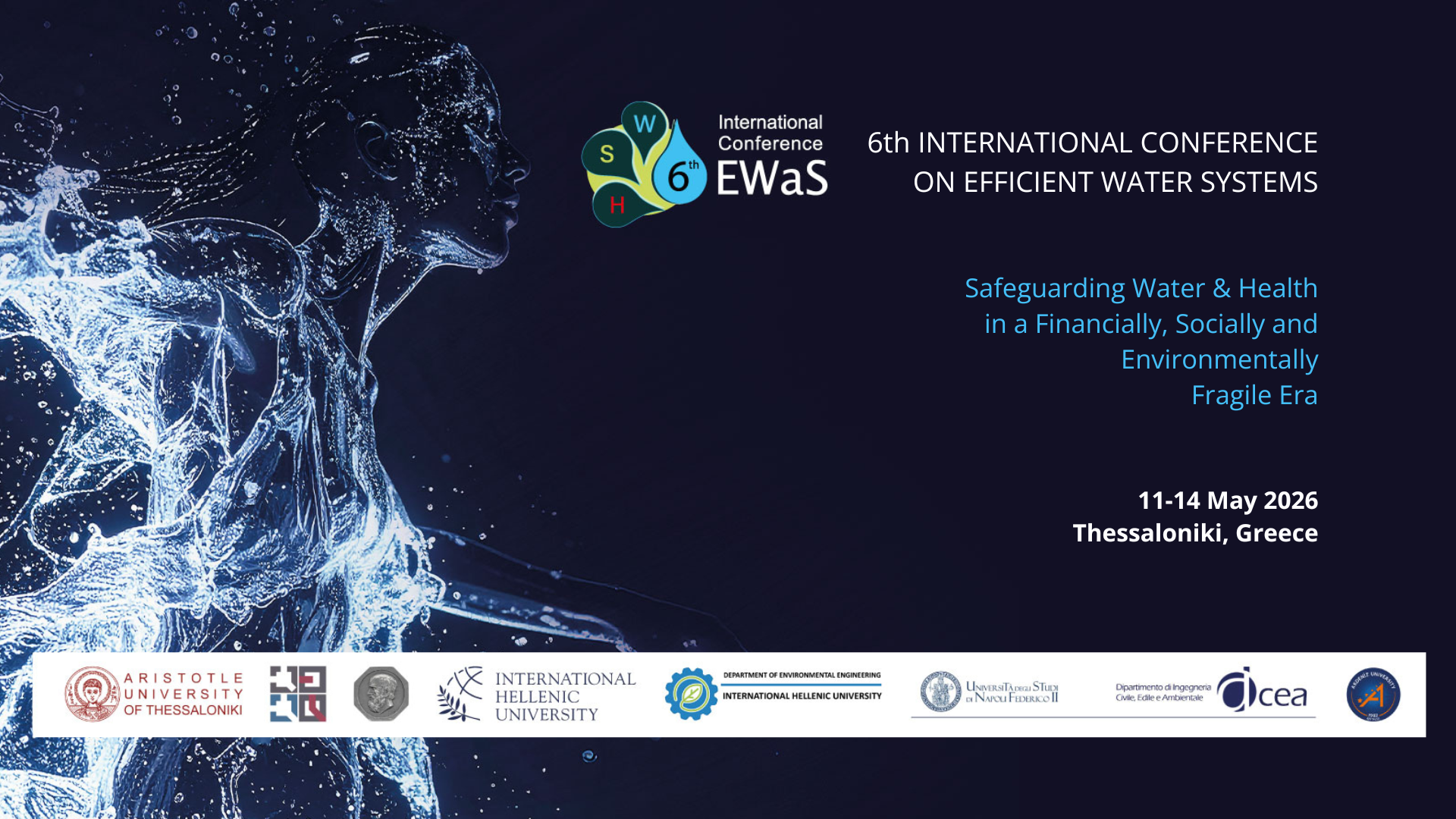
6th EWaS (Efficient Water Systems) International Conference:
“Safeguarding Water & Health in a Financially, Socially and Environmentally Fragile Era”
11-14 May 2026, Thessaloniki, Greece
Co-organized by
The Civil Engineering Dept., Aristotle University of Thessaloniki, Greece
Τhe School of Medicine, Aristotle University of Thessaloniki, Greece
The Environmental Engineering Dept., International Hellenic University, Greece

The Civil, Architectural and Environmental Engineering, University of Naples Federico II, Italy

The Faculty of Engineering, Environmental Engineering Dept., Akdeniz University, Türkiye
Abstract Submission: https://ewas6.alphaconferences.gr/calls-submissions/
Registrations: https://ewas6.alphaconferences.gr/registration/
Conference Topics
1. Applied Fluid Mechanics/Dynamics and Hydraulics
1.1. Newtonian and non-Newtonian Fluid mechanics/dynamics
1.2. Computational Fluid Dynamics
1.3. Experimental and computational methods in hydraulic engineering
1.4. Hydrodynamics and Waves (including microplastics move in the marine environment
1.5. Freshwater pipe networks modelling
1.6. Irrigation pipe/canals systems modelling
1.7. Groundwater flow modelling
1.8. Biofluid Mechanics
1.9. Flow models in arteries and veins
2. Hydrology and Water Resources
2.1. Hydrological response to Climate Change
2.2. Integrated Water Resources Management
2.3. Sustainable water management and circular economy
2.4. Environmental crisis and hazards (e.g.: flash floods; droughts; NBSs for resilient systems)
2.5. Natural Disasters and Climate Hazards: the impact on the water cycle
2.6. Non-conventional water resources (e.g.: desalination, rainwater harvesting, yellow water)
2.7. Riverine and coastal engineering (including coastal floods)
2.8. Big data management and modelling for risk assessment
2.9. Geo-information and Water Resources
3. Water distribution systems planning and management
3.1. Hydroinformatics and Smart systems (Smart Water Networks and IoT Solutions)
3.2. Cyber security addressing emerging threats
3.3. Innovative methods for urban full water cycle management (smart/mega cities; water-energy recovery in water systems; economy of scale-based solutions)
3.4. Remote Sensing and New Technologies in the Water Business (Big Data-ML techniques/analysis)
3.5. AI and its use in the water business: pros and cons
3.6. Asset management (repair vs. replace dilemma; SCADA, GIS, BIM, ICT applications)
3.7. Digital Transformation in Water Networks (digital wins and mimic diagrams)
3.8. Water demand patterning, prediction and control
4. Water loss management
4.1. Water balance and NRW reliable assessment (dealing with errors)
4.2. Active leakage control practices, technologies and equipment
4.3. Pressure management (Network Zoning, PMAs, DMAs)
4.4. Smart monitoring and predictive analytics (sensors and other monitoring devices)
4.5. Advances in customer metering and management
4.6. Addressing post meter leakage
4.7. Performance Based Service Contracts for NRW – Funding NRW Projects
4.8. New trends in total water loss reduction
4.9. Benchmarking in water distribution networks, experience exchange and capacity building (Reviews and case studies)
5. Intermittent Supply in urban water systems
5.1. Intermittent water supply: modelling, operation and optimization
5.2. Demand modelling within intermittent supply conditions
5.3. Safety, resilience and reliability of Intermittent water supply systems
5.4. Water quality in Intermittent Water Systems
5.5. Restoring continuous water supply impacts
5.6. Transients’ analysis
6. Urban Water and Health Nexus
6.1. Natural Disasters and Climate Change Hazards: Health Related Issues
6.2. Tracing viruses and pathogens in water/Biomonitoring: Wastewater-Based Epidemiology (WBE)
6.3. Waterborne diseases: exposures and human health (the meta Covid-19 era)
6.4. THMs and disinfection hazards
6.5. Antibiotic resistance
6.6. Drinking water safety: treatment predominant practices, new trends and nanomaterials
6.7. Nano biomechanics
6.8. Study of the biological behavior of biomaterials
6.9. Pollution control and contaminated sites: safeguarding public health
7. Advances in urban drainage and sewers
7.1. Advances in sewer and drainage modelling and design
7.2. Flash floods Impact on Urban Drainage Systems
7.3. Storm water quality modelling, including sediment and pollutant transport
7.4. Storm water control: sustainable urban drainage solutions and NBG solutions
7.5. Combined Sewer Overflow solutions
7.6. Reliability and resilience in the urban drainage systems
7.7. SWAT, SWMM and other modelling tools case studies
8. Governance and Ethics
8.1. Social, Political, Organizational, Institutional, Legislative Aspects, and Ethics
8.2. Economics and Financing Issues: Socially fair full water pricing (NRW reduction projects too)
8.3. Cross-sectoral governance: Partnerships and cooperation in the water sector
8.4. Collaboration of local and regional government agencies with water providers
8.5. Impacts of digital transformation on society, citizens, and business
8.6. ESG (Environmental, Social and Governance) and circular economy
8.7. Environmental vulnerability, risk management, sustainability & the SDGs
8.8. Carbon footprint-based management
8.9. Climate Change forced immigration
8.10. Personal data utilization and protection of civil rights
9. Medical Issues related to human body hydraulics/fluid mechanics
9.1. Cardiovascular Diseases (atherosclerosis, hypertension, pulmonary embolism)
9.2. Respiratory disorders (asthma, COPD, ventilators)
9.3. Circulatory support (ECMO)
9.4. Neurology, neurosurgery and neuroradiology (stroke, aneurysms, spine diseases)
9.5. Adult & Pediatric cancer (drug delivery and tumor perfusion, solid tumors, leukemia)
9.6. Endocrinology (hormonal imbalance, diabetes, osteoporosis)
9.7. Obstetrics (pregnancy complications)
9.8. Cardiothoracic and vascular surgery (aneurysms, stents, valves and bypass grafts)
9.9. Ophthalmology (glaucoma, intraocular pressure)
9.10. Infectious Diseases (pathways of transmission)
9.11. Kidney and Dialysis systems
9.12. Rheumatology (autoimmune diseases)
9.13. Gastroenterology (liver and colon diseases)
9.14. Orthopedics and Joint Diseases (osteoarthritis, fractures)
9.15. Radiology, radiodiagnostics, radiotherapeutics